When millions of users publish web content using identical synthetic clichés and formulaic structures, the internet becomes saturated with predictable noise known as AI SlopGlosarioAI SlopTérmino que define la morralla, bazofia o contenido basura generado en masa por modelos de inteligencia artificial sin supervisión ni valor editorial. Proviene del inglés slop (literalmente la comida de desperdicios o sobras que se echa a los cerdos). En la cultura digital representa el sucesor directo del spam: textos inflados, imágenes clónicas, código genérico y relleno algorítmico sin criterio ni alma que saturan internet y provocan el colapso de los propios modelos al retroalimentarse de su propia basura.Ver término completo →. What feels like mild stylistic irritation to an everyday reader has rapidly escalated into a major architectural roadblock for the labs building frontier models.
If newer generations of large language models are trained on open-web corpora heavily polluted with previous synthetic outputs, they begin to feed on their own statistical biases. In computer science, this degenerative loop is known as Model CollapseGlosarioModel CollapseDegeneración progresiva y pérdida irreversible de calidad que experimenta un modelo de lenguaje o de inteligencia artificial cuando se entrena con datos generados por otros modelos en lugar de contenido producido por humanos. Al alimentarse de su propia producción sintética, el algoritmo amplifica los sesgos estadísticos, empobrece su riqueza léxica y colapsa su capacidad de razonamiento.Ver término completo →. By consuming its own verbose prose, the algorithm amplifies statistical noise, suffers severe lexical shrinkage, and experiences irreversible degradation in its core reasoning capabilities.
Here lies the foundational Silicon Valley paradox:
- The paradox of abundance versus genuine scarcity: while more digital text is generated per second than at any prior point in human history, the open web has become virtually unusable for frontier training because synthetic sludge has polluted the public data pool.
- The paradox of the digital future versus analog print: for 21st-century neural networks to keep scaling toward Artificial General Intelligence (AGI), Big Tech companies desperately depend on the most traditional medium available: physical books printed before 2022, when human writing was still 100% genuine and unpolluted.
In their seminal study Will we run out of data? Limits of LLM scaling based on human-generated data, research institute Epoch AI estimates the total global stock of quality human-generated public text at approximately 300 trillion tokens. At current scaling trajectories, frontier models will fully exhaust this stock between 2026 and 2032 (or sooner under aggressive overtraining). This shortage has propelled labs into buying entire libraries of pre-2022 physical volumes and signing multimillion-dollar licensing deals with academic publishers.
They acquire massive lots of second-hand books because material printed before 2022 is guaranteed to be 100% free of synthetic noise.
Spines are sliced off with industrial guillotines to feed loose sheets through high-speed scanners. Paper is immediately pulped to avoid storage costs and protect against copyright liability.
They sign licensing agreements with academic publishers (like Wiley or Taylor & Francis) to feed models with millions of dense, peer-reviewed papers.
The goal of this frantic race is to salvage what trillions of neural parameters cannot synthesize autonomously: authentic, assertive, asymmetric human language free from synthetic scaffolding.
Why Current AI Anti-Slop Solutions Fall Short
Confronted by the data wall and persistent writing clichés, the research community has attempted various probabilistic patches during inference and alignment. In June 2026, researchers Allen Roush and Parag Mahajani from Thoughtworks AI Labs published a comprehensive breakdown of the limitations in traditional anti-slop methods (Anti-slopping: An innovation for rectifying LLM writing clichés):
| Technical Strategy | How It Works | Limitation Against AI Slop |
|---|---|---|
| Top-k, top-p & min-p | Sampling filters over token probability tails. | Fails to fix syntactic inertia: text still converges to predictable templates. |
| RLHF (Human Alignment) | Retraining with human evaluators penalizing cliché phrasing. | Slow, costly, and induces biases like compulsive didacticism and over-politeness. |
| XTC (Exclude Top Choices) | Drops the #1 token when it exceeds a confidence threshold. | Only affects isolated high-probability tokens, blind to multi-word phrases. |
| DRY (Don't Repeat Yourself) | Penalizes tokens already present in recent context. | Prevents exact word repetition, but blind to abstract syntactic molds. |
| String Banning (ExLlama) | Hard blocking of fixed token sequences at runtime. | Blocks words rigidly, breaking valid vocabulary and forcing pretentious synonyms. |
| Pruned Beam Search | Explores generation trees, pruning forbidden branches. | Heavy computational overhead and structural rigidity without adding burstiness. |
| DPO (Direct Preference Optimization) | Optimizes preferences directly without a reward model. | Can trigger a diversity collapse, sharply reducing vocabulary and n-grams. |
The Thoughtworks Proposal: Backtracking Sampler & FTPO
To break through these bottlenecks, the Thoughtworks team designed a two-tiered innovation:
- The Anti-Slop Backtracking Sampler: while generating text word by word, the algorithm monitors a banlist of forbidden clichés. If the model starts writing "In the ever-evolving landscape of technology...", the system halts instantly, wipes those tokens, steps back to the sentence junction, and applies a mathematical soft-ban penalty to that branch. It then uses min-p sampling (a filter that only considers candidate tokens whose probability is at least a dynamic fraction of the top option, pruning out unnatural gibberish) to pick a direct alternative like "In modern software engineering...".
- FTPO (Final Token Preference Optimization): backtracking at inference time solves clichés but remains unsustainable at scale by degrading generation throughput by 69% to 96%. To eliminate this latency bottleneck, Thoughtworks engineered FTPO: they use the backtracking sampler during a lightweight training phase to log every precise decision point where the model oscillated between a cliché and a natural phrasing. By updating token probability scores (logits) exclusively at that critical decision junction, the fine-tuned model natively develops the intuition to write clean, unbloated prose, preserving 100% of its native inference speed while keeping its core reasoning benchmarks intact.
Research Results: FTPO vs. Traditional DPO
Benchmarked on models like Gemma-3-12b across banlists of 1,000 to 8,000 patterns, experimental findings demonstrate why traditional methods degrade output while FTPO preserves quality:
| Evaluated Parameter | FTPO (Thoughtworks) | Traditional DPO |
|---|---|---|
| Suppression Effectiveness | Suppresses 85% to 90% of slop (+8.5% stronger). | Suppresses 80–82% before sharp quality degradation. |
| Writing Quality | Preserves baseline score intact (~78/100). | Catastrophic quality collapse (drops from 78 to 15/100 as accuracy rises). |
| Lexical Diversity | Retains or boosts vocabulary (95–102% of baseline). | Progressive collapse of unique words and n-grams (74–92%). |
| Math & Reasoning | Preserves GSM8k and MMLU within 1–3% of baseline. | Degrades general reasoning benchmarks by 2–5%. |
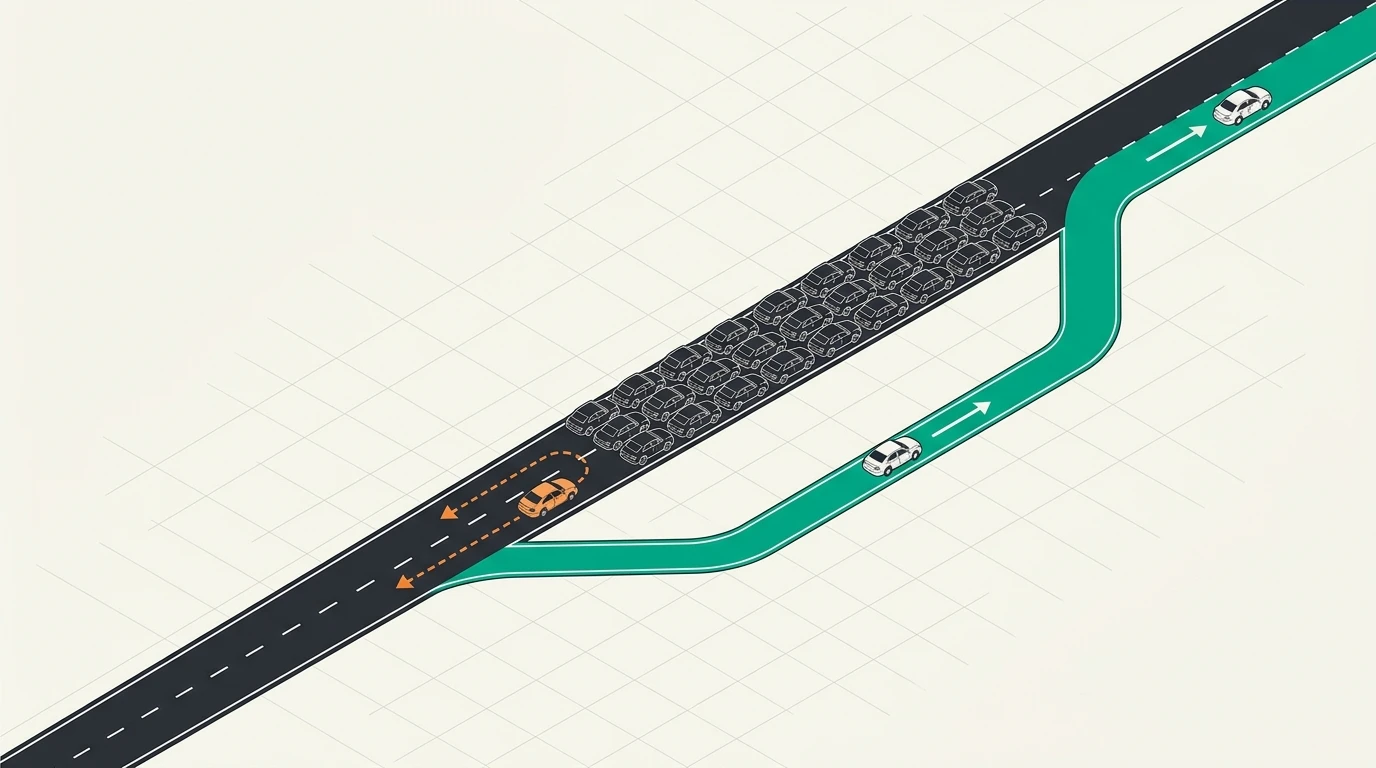
ANALOGY — Imagine driving with a GPS navigation system that stubbornly routes you into the exact same highway traffic jam (the AI cliché).
- Backtracking is like realizing you are stuck after entering the jam, which forces you to reverse several miles, switch lanes, and find an alternative exit. You reach your destination cleanly, but you wasted enormous time.
- Traditional DPO works like banning entire road categories; that is, it avoids the traffic jam, but the GPS gets confused, forgets basic shortcuts, and drives erratically.
- FTPO surgically updates the GPS map memory so it learns to take a smooth right turn just before the jam, keeping full speed without braking or losing its sense of direction.
Both the sampler pipeline and the training datasets have been released under an open-source license on GitHub: sam-paech/auto-antislop.
To learn how to detect and eliminate these same synthetic tics in your own daily writing, check out our practical guide: AI SLOP. Smells Like AI Spirit. Why Does My Writing Taste and Smell Like AI? →